Need Help? Call or Text: (918) 420-9999
Need Help? Call or Text: (800) 420-9767

An Independent Insurance Agency
Questions? Call (918) 420-9999
Need Help? Call or Text: (800) 420-9767

Why Are There Four Parts?
Medicare grew over time to cover more needs, which is why it ended up split into separate parts instead of one all-in-one plan. Each part was added to fill a specific gap: hospital care, doctor visits, private plan options, and prescription drugs.
Maybe this sounds familiar:
- I assumed Part A and Part B covered everything.
- I don't know which parts I actually need.
- I'm afraid I'll pick wrong and get stuck with the bill.
- Everyone who calls me is trying to sell me something.
None of that means you are behind. It means no one has explained the four parts clearly yet. Once you see what each one does, it is much easier to see which combination fits your situation.
Part A and Part B: Original Medicare
Original Medicare is run by the federal government and comes in two parts. Together, Part A and Part B are what people mean by "Original Medicare."
Hospital Insurance
Covers inpatient hospital care, skilled nursing, hospice, surgery, and home health care. Deductibles and cost-sharing apply. Most people pay no Part A premium.
Medical Insurance
Covers doctor visits, preventive care, outpatient services, and lab tests. Part B has a monthly premium, plus a deductible and cost-sharing.
What Original Medicare does not cover
This is the part that catches people off guard. On its own, Original Medicare generally does not include:
- Prescription drug coverage. That is Part D, offered through private plans.
- Routine dental, vision, and hearing care.
- An annual cap on your out-of-pocket costs.
That does not mean you are stuck. It means Original Medicare is a foundation, and most people add something to it.

Where Parts C and D Fit In
What is Part C?
Part C, also known as Medicare Advantage, is a different way to receive your Medicare benefits. A Medicare Advantage plan bundles Part A, Part B, and usually Part D into one plan with a private carrier. Learn more about Medicare Advantage.
What is Part D?
Medicare Part D helps pay for prescription medications. It is available as a stand-alone plan (PDP) that works alongside Original Medicare, or as part of a Medicare Advantage plan. Part D plans are offered by private insurance companies contracted and approved by Medicare. Learn more about Prescription Drug Plans.
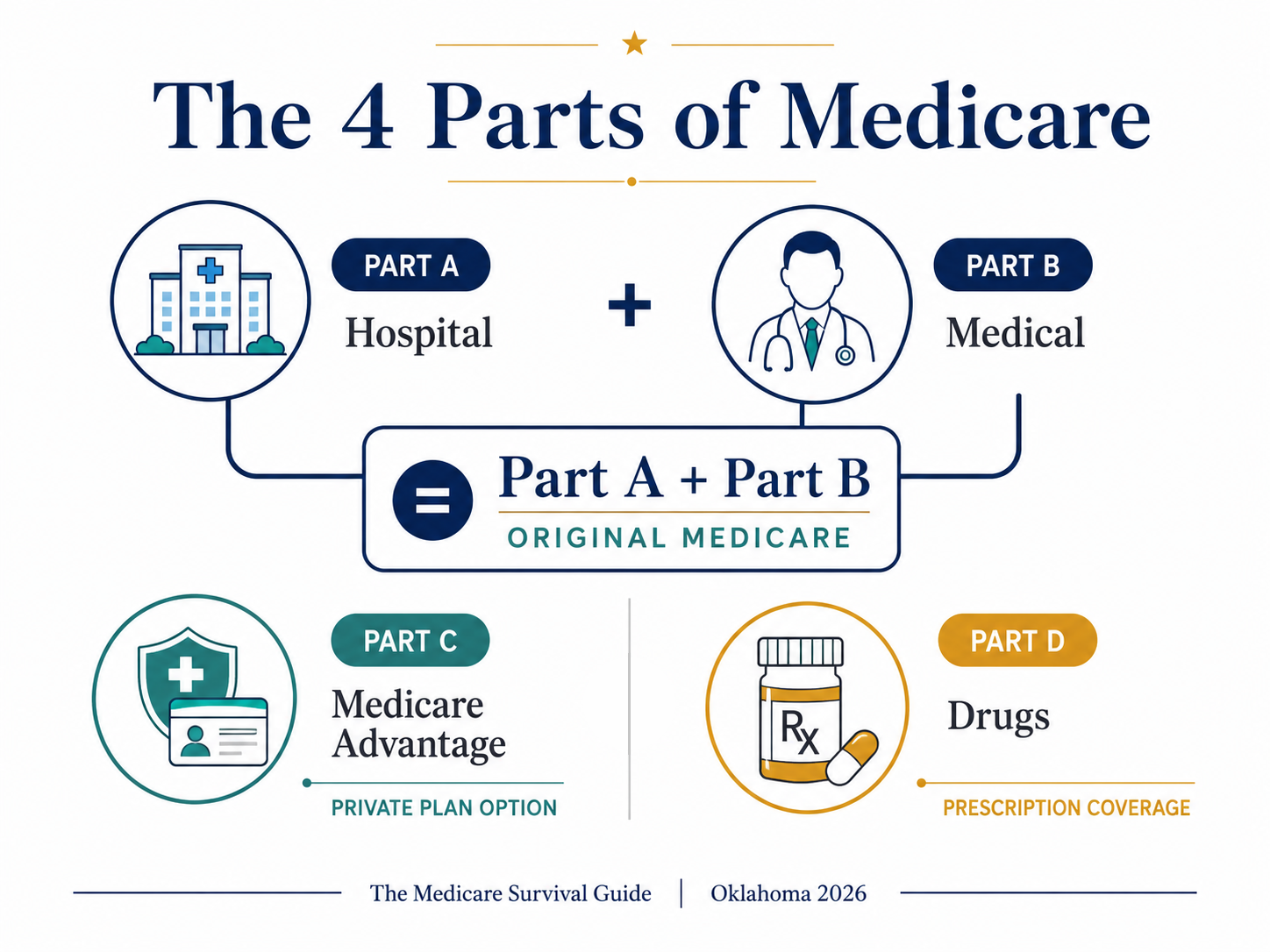
The 4 Parts at a Glance
One picture that puts the alphabet in order. Download it, print it, or keep it on your phone for your next appointment.
Which Combination Is Right for You?
Original Medicare plus a Supplement and Part D
Parts A and B, a Medigap plan to pick up the gaps, and a stand-alone drug plan. Any doctor who accepts Medicare, nationwide, with predictable costs.
Medicare Advantage (Part C)
One plan and one card that bundles hospital, medical, and usually drug coverage, often with dental, vision, and hearing, in exchange for using the plan's network.
Talk it through first
Your doctors, medications, budget, and travel plans decide which one fits. We compare both side by side with you, at no cost to you, and we are not tied to a single plan.
Common Questions About the Four Parts
Do I need all four parts?
No. Everyone on Medicare has Part A and Part B. From there you either add a Part D drug plan (and usually a Supplement), or you choose a Medicare Advantage plan (Part C) that bundles Parts A, B, and usually D together. You would not have Part C and a separate Supplement at the same time.
Is Part A really free?
Most people pay no monthly premium for Part A because they or a spouse paid Medicare taxes for at least 10 years. It is not cost-free when you use it: there is a hospital deductible per benefit period and daily costs for longer stays.
What is the difference between Part C and a Medicare Supplement?
Part C replaces the way you receive your Medicare benefits through a private plan with a network. A Supplement (Medigap) rides alongside Original Medicare and pays what Medicare leaves behind, with no network. They solve the same problem two different ways.
Can I change my mind later?
Yes, during the right window. The Annual Enrollment Period runs October 15 through December 7 each year, and there are other windows for special situations. See our Enrollment Periods page.
Still not sure which parts you need?
Everyone's mix of A, B, C, and D looks a little different depending on health needs, budget, and the doctors they want to keep. Talk it through with someone who is not selling a specific plan.

Grab Our Free
Comprehensive Guide to Medicare!
Medicare can be a nightmare to understand. We've helped hundreds of Baby Boomers navigate this journey, and we hope this book can help you too!